
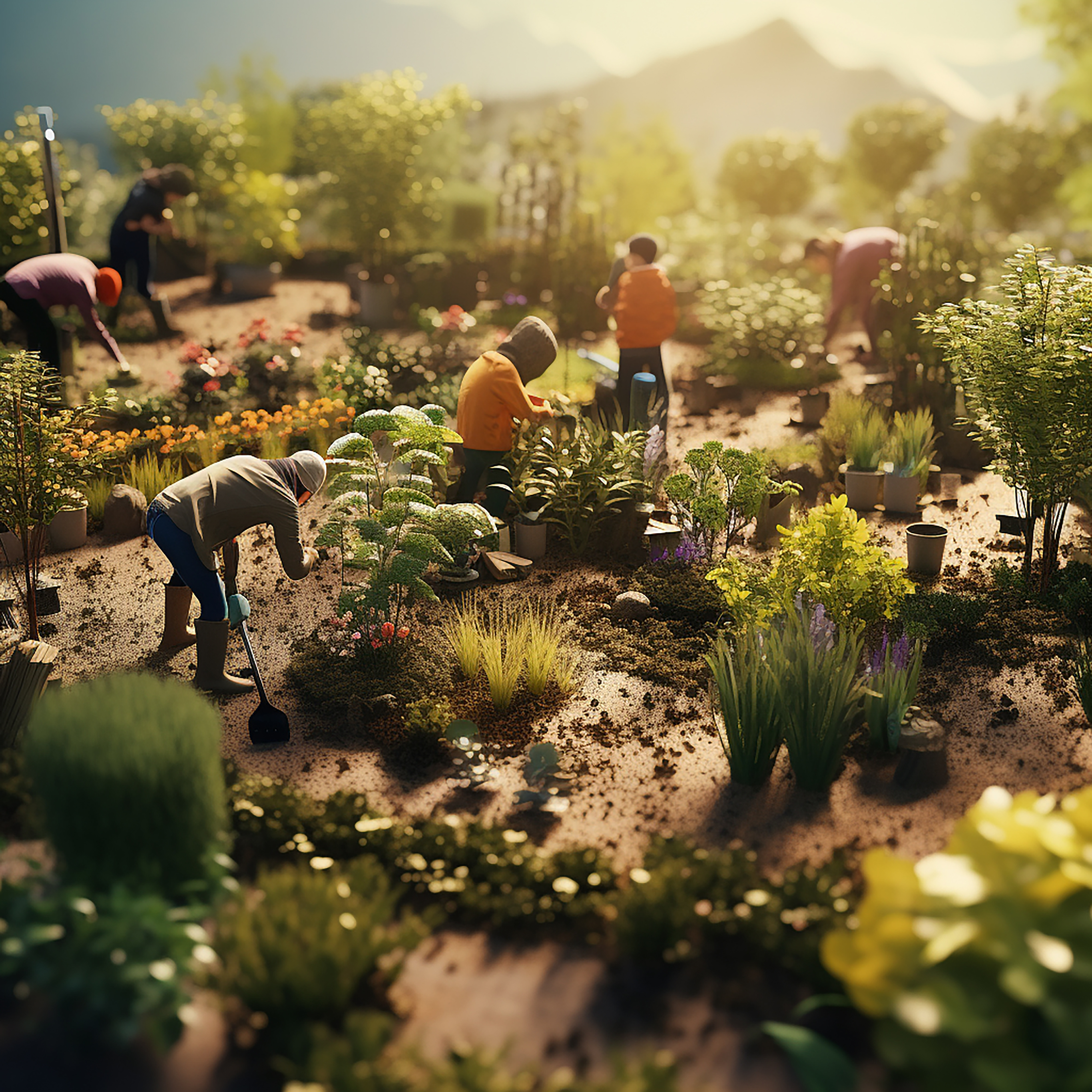

A two-year climate resilience programme (December 2025 -December 2027) targeting 400 smallholder farmer households across seven valleys in Gilgit-Baltistan and Chitral. The project strengthens climate-adaptive agricultural livelihoods through climate-smart agriculture, women-led greenhouses, efficient water management, green enterprise development, and sustainable natural resource management.
The Context:
Pakistan’s high-altitude mountain regions, particularly Gilgit-Baltistan and Chitral, are among the most climate-vulnerable landscapes in the world. Less than 2% of land is cultivable, and communities face existential threats from glacial lake outburst floods (GLOFs), erratic rainfall, and prolonged lean seasons that stretch food insecurity to three months of the year. These fragile mountain ecosystems support livelihoods intrinsically dependent on agriculture and natural resources, yet communities lack access to modern inputs, resilient seeds, efficient irrigation, and market linkages.
Women and youth are disproportionately affected, often excluded from economic opportunities and climate adaptation decision-making. Without targeted, locally embedded interventions that address both environmental and social dimensions, mountain communities remain trapped in cycles of vulnerability. CRASVC was designed to respond directly to this gap, translating Pakistan’s national climate adaptation priorities, including the National Climate Change Policy (2021), Water Policy (2018), and NDC commitments under the Paris Agreement, into locally grounded, evidence-based action.
The Approach:
CRASVC adopts an integrated, community-centered approach combining climate-smart agriculture, gender inclusion, natural resource management, and green entrepreneurship. The programme is structured around five core intervention areas:
The programme leverages AKRSP’s 40-year institutional presence and network of 4,700+ Village and Women’s Organizations to ensure deep community ownership, gender-disaggregated monitoring, and long-term sustainability beyond the project cycle.
Results & Impact:
CRASVC is expected to deliver transformative outcomes across four result areas. First, strengthened climate resilience for 400 smallholder farmer households through the adoption of climate-smart agriculture and regenerative farming practices. Second, improved food security with the lean season reduced from three to two months through diversified production, enhanced irrigation efficiency, and resilient inputs. Third, enhanced women’s economic participation through 26 women-led passive solar greenhouses, gender-responsive training, and women-led micro-grants and enterprises. Fourth, operationalized community-owned water and NRM systems, with tested high-value crop pilots and green business solutions creating replicable models for resilient mountain agriculture.
The project allocates 65% of its investment to climate adaptation, while the remaining 35% goes towards achieving other green and environmental objectives. It directly advances Pakistan’s NDC commitments and Danish priorities on climate adaptation, inclusive green growth, and women’s economic empowerment.
 |
 |
 |
 |
 |
Insights & Replication Potential:
A central lesson from CRASVC’s design is that effective climate adaptation in mountain ecosystems requires simultaneous action on agricultural productivity, gender inclusion, water management, and market access, no single intervention is sufficient in isolation. AKF and AKRSP’s 40-year institutional track record and deep community networks are critical enablers, ensuring that technically-sound interventions translate into locally owned and sustained change.
Key risks, including extreme climate events, limited market access, gender norm barriers, and governance gaps, are proactively mitigated through climate-resilient site design, early value chain mapping, gender-sensitive programming with dedicated PSGHs, and structured provincial policy engagement. These risk mitigation mechanisms are themselves replicable models for future mountain agriculture programmes.
The CRASVC framework has high replication potential across other high-altitude districts in Pakistan, including Hunza, Ghanche, and Upper Dir, as well as in comparable mountain ecosystems in Afghanistan, Tajikistan, and the Hindu Kush–Himalayan region. Its modular design, combining CSA, women-led enterprises, water management, and policy engagement, can be adapted to different agro-ecological and institutional contexts with appropriate local partnerships and data systems.